Decentraland DAO Grants Program: Quarterly Insights
By Decentraland DAO, , in Announcements
Decentraland’s DAO Grants Program is one of the platform’s best vehicles to help grow the Decentraland ecosystem. It does so by funding community projects that enrich and enhance the Decentraland experience such as experiences like Vroomway and Wilderness P2E, tools like DCL Metrics and WeMeta, and many other activities. As Decentraland has grown overtime and gained experience in how its community operated within the DAO, it is natural that the programs within it should evolve to serve the community best. The following is a review of the past three months of the Grant Program which evaluates changes to the grant system that were put in place in March 2023 after a similar review of last year’s grant activities.
Upon analyzing the community grant of 2022, it was determined that Grant Program’s categories were too broad and needed more clearly defined requirements and impact measurements. The grant categories of the old grant system were:
Community: Education, outreach, events, and moderation
Content Creator: Scenes and models for Decentraland
Platform Contributor: New features and improvements to existing code
Gaming: Complete games for Decentraland
As a result, a new system was proposed and voted through to approval in the DAO in December of 2022. Going into action in March of 2023, the new grant system offered opportunities and set requirements in the following categories:
Core Unit: Provide core infrastructure and operations for the DAO through the work of official DAO representatives. Learn more about the three main Core Units of Decentraland’s DAO.
Platform: Creation of tools and applications that extend the power of the Decentraland platform or provide alternative ways to explore Decentraland’s ecosystem.
Documentation: Creation of free educational content about how to contribute, build, and play in Decentraland.
In-World Content: Development of attractive experiences in Decentraland, such as scenes, games, and events that generate retention of users.
Social Media Content: Projects to create content on social media platforms such as Twitch, Twitter, Youtube, Tik Tok, and Discord that will reach new users and keep them engaged.
Sponsorship: Supporting conferences, side events, community meetups, hackathons, and contest prices that target audiences relevant to Decentraland.
Accelerator: A private company or revenue-generating initiative looking forward to receiving an investment from the DAO.
By reviewing the results of Q2, which covers April, May, and June of 2023, three of the four months since the changes to the Grant Program were implemented, the following conclusions and questions can be drawn regarding the new system and categories:
The grant funds were not used in the expected categories
Some of the current categories are still too broad and sometimes misused—does the Grant Program need a new category?
Each category should have its requirements and impact measurements improved
The Documentation grant category’s requirements need to be more specific
The grant funds were not used in the expected categories
Q2 grant numbers:
First time grants:
Eight (8) first time grants were requested totalling a cost of $375,925 DAI
Four (4) of the above grants were requested in the wrong category totalling a cost of $287,700 DAI
One of the grants requested in the wrong category was requested so because the correct category (Accelerator) had already run out of funds. The total cost of this grant was $110,000 DAI.
Grant renewals:
Four (4) pre-existing grant projects requested funds for the second time totalling a cost of $352,100 DAI
Two (2) Core Unit category grants requested funds for the third time to serve the community, totalling a cost of $213,100 DAI
Funds recovered:
One (1) grantee stepped down from their grant and wasn’t funded again during Q2, resulting in $110,000 DAI being returned to the DAO.
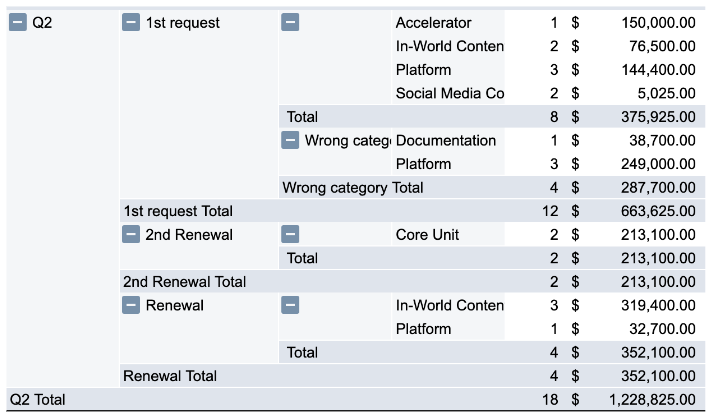
Disclaimer: The following is a snapshot taken on July 3rd, after the end of Q2. However, four grants, which started in Q2, could still change the allocations of these budgets.
Q2 grant category numbers:
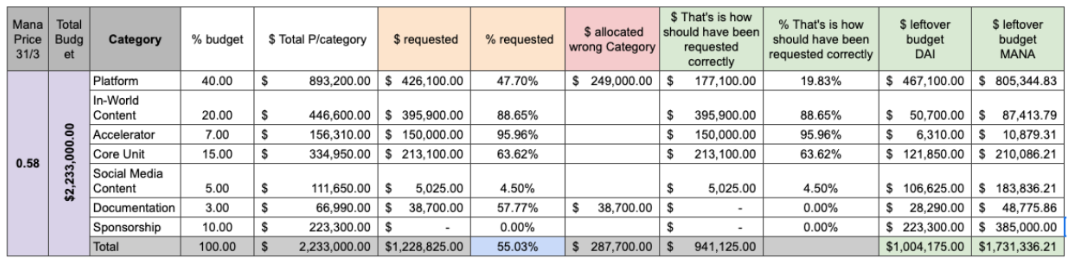
Link: Pivot Table — Graphic
Platform: 47.7% of the available budget was used to finance projects. However, considering the grants requested in the wrong categories, 19.83% ($177,100 DAI) is the actual percentage requested.
In-world Content: 88.65% of the available budget was requested ($395,900 DAI)
Accelerator: 96.96% of the available budget was requested ($150,000 DAI)
Core Unit: 63.62% of the available budget was requested ($213.100 DAI)
Social Media Content: 4.5% of the available budget was requested ($5,025 DAI)
Documentation: 57.77% was used to finance projects. However, considering the grants requested in the wrong categories, 0% ($0 DAI) is the actual percentage of the available budget requested.
Sponsorship: 0% of the available budget was requested.
Finding: A governance proposal should be drafted to ask the community if the allocation of funds per category should be redistributed in the Grants Program budgeting system. For example, providing more funds to the Accelerator category and fewer funds to those not used.
Some of the current categories are still too broad and sometimes misused—does the Grant Program need a new category?
During Q2, grants were requested that could fit into two or more categories or that the appropriate category may not currently exist, so the categories need to be better defined so they are self-explanatory.
One example is the type of grant that aims to onboard new members to Decentraland for specific target audiences, such as DCL Brazil. In this case, the grantee requested a proposal to grow and maintain the DCL community in Brazil. This project had a broad scope and had activities from many categories, even though they submitted their application under the Documentation category. As a recommendation, the Grant Support Squad suggested they focus the scope based on the impact metrics of a particular category, and later the applicants submitted a proposal under the In World category.
There have been other projects/initiatives from valuable DAO members that make community-building experiences, events and share knowledge with newcomers and ignite interaction among Decentraland users and DAO members, yet there isn’t a current category that is the right fit in regards to performance metrics for this type of work.
Finding: We should create a DAO governance proposal to add the Community Experiences category, to empower community members and, in partnership with the Facilitation Squad to define requirements and performance metrics, redistribute the percentages of the allocation of the Grants Program budgeting system.
This category would be dedicated to recognizing and supporting individuals or groups who actively contribute to the growth, development, and engagement of the Decentraland community, fostering collaboration and positive experiences within the metaverse.
As a kickstart, the Grant Support Squad made an analysis. The following could be used as a first draft:
The working group should define the Requirements for Community Experiences Category, such as:
Demonstrated commitment to Community Experiences within Decentraland: Proven track record of organizing and facilitating community events, initiatives, or educational programs.
Define the criteria of relevant participation in community forums, social media groups, or other channels to provide support and guidance to community members.
The proposal should include how they will collaborate with other community builders, Core Units, or projects within Decentraland to foster cross-community partnerships.
The proposal should include the development of resources, tutorials, or guides that help onboard and engage new community members for these experiences.
The working group should define the Performance Metrics:
Number of community members engaged or impacted through Community Experiences initiatives.
Feedback and testimonials from community members regarding the value and impact of their contributions.
Attendance and participation metrics in community events, workshops, or educational programs.
Growth and activity metrics of the community platforms, forums, or social media groups facilitated by the Community Experiences
Number of successful cross-community collaborations or partnerships facilitated by community builders.
What is the difference between this Community Experiences and the current In World Content or Social Media Content?
If the category gets approved by the community, we suggest making the following adjustments to the current categories, to cover the vast array of our community’s proposals: In world building (current In-world content): Aims to build architecture to populate Land. The experiences can be in the form of scenes and games for Decentraland users through the reference client. Community experiences (this new category): Aims to bring people together in the reference client to generate community engagement. This can include creating wearables and emotes, or organizing events to gather with others and ignite fun community interactions. Social Media (currently has the same name): Aims to generate social media content to bring new audiences to Decentraland.
Certain categories should have their requirements and impact measurements improved
The new Grant Program framework launched in March 2023 defined specific requirements and impact metrics for each category. After a few months in action, certain grant activities showed that there was a need for additional impact metrics to account for different types of projects.
During Q2, the grant project Meeple Madness, requested in the In-world Content category, was completed and demonstrated that it fulfilled the proposal as expected. The project involved a game experience during MVFW23 which, if completed, allowed participants to claim a Wearable. The performance metrics for the In-World Content category are: Newly Populated Land, Active Users, Returning Users, Time on Scene, Events Created, and Number of Event Attendees. The case of Meeple Madness made it clear that the metrics Minted Wearables and Claimed Wearables should also be added to the performance metrics of the category as they are a relevant metric of success in Decentraland.
As for the Core Unit grant category, at this time, each Core Unit defines their own performance metrics based on the needs of the community today which varies from unit to unit, however, it would be beneficial to define common impact metrics that are suitable for the Core Units category.The community’s strategic planning working group is currently developing a high level strategy for the DAO, Once that is established, the Grant Support Squad will work on a 3–step Governance Proposal to define the common impact metrics for the Core Units category.
The Documentation grant category’s requirements need to be more specific
The Category Documentation: as we started to work with the new framework of the grant program, we noticed that the category says:“Creation of free educational content about how to contribute, build, and play in Decentraland. The content should be published in official mediums to be found and preserved for posterity.”
Requirements:
The topic shouldn’t be already well-covered in the official documentation.
Provide examples of documentation done in the past.
Describe the format of the documentation to be produced.
To be published in an official medium.
Performance Metrics:
The number of contributions to Decentraland Documentation
The number of contributions to the Awesome Repository.
Finding: We need to better define what “official documentation”, “official mediums”, and “number of contributions” means and add these to the Grants Program Documentation category
Official documentation is the information published in Decentraland Documentation as well as the content within the Awesome Repository.
Official mediums are those managed by the Decentraland DAO and Foundation, such as:
Decentraland Foundation Blog
Awesome Repository
Decentraland Documentation
Decentraland DAO youtube channel / social media
Decentraland Foundation Youtube Channel / social media
Contributions requirements and examples can be found within the guidelines on “How to contribute” to the Awesome Repository are written in Contributing.md.
The number of contributions to Decentraland Documentation is measured by the number of pull requests (contributions to the code) made in the Decentraland repository. The idea is that the grantee making the pull request makes one pull request per contribution.
The Grant Support Squad has added these changes to the Grants Program Documentation to make it explicit for grants in the future to avoid submissions in the wrong category.
Reminder: according to the Awesome Repository contribution guidelines, the content should be written in English to ensure the majority of the users-audience. A pitch proposal is waiting to be escalated to a tender to translate documentation.
Conclusion
After analyzing the Decentraland DAO Grants Program over Q2, several insights and areas for improvement have emerged. The funds allocated to grants were not always used in the expected categories, indicating a need for a redistribution of funds. The current categories were found to be too broad and occasionally misused, highlighting the necessity of better defining the categories to avoid ambiguity and misclassification of projects.
One notable observation was the importance of community builders and their valuable contributions to the Decentraland ecosystem. To recognize and support these individuals and groups, a new category called “Community Experiences” was proposed inside the Grant Support Squad team, and we are proposing it through a governance poll. This category aims to empower community members and foster engagement, collaboration, and positive experiences within Decentraland. Defining clear requirements and performance metrics for this category will be crucial to ensure its effectiveness. The Grant Support Squad and the Facilitation Squad should collaborate to define the requirements and performance metrics for the new Community Experiences category and ensure a balanced allocation of the Grants Program budget.
Improving the requirements for the Documentation category is another important step. Clarifying the definition of “official mediums” for publishing content. Additionally, the inclusion of explicit language stating that content should be written in English is necessary to avoid funding Documentation that the majority of the community cannot use.
Furthermore, the need for better-defined requirements and impact measurements for certain categories was emphasized. This includes the Core Unit category, where common impact metrics need to be established to align with the strategic planning efforts of the DAO.
In conclusion, by addressing these identified areas for improvement, the Decentraland DAO Grants Program can become more effective, better aligned with community needs, and facilitate the growth and development of the Decentraland ecosystem. Regular reviews, community feedback, and ongoing evaluation will be essential to improve and adapt the program to achieve its goals continuously.
The DAO's Grant Support Squad